Complete Guide to Taking an Electronic Prototype to Mass Production
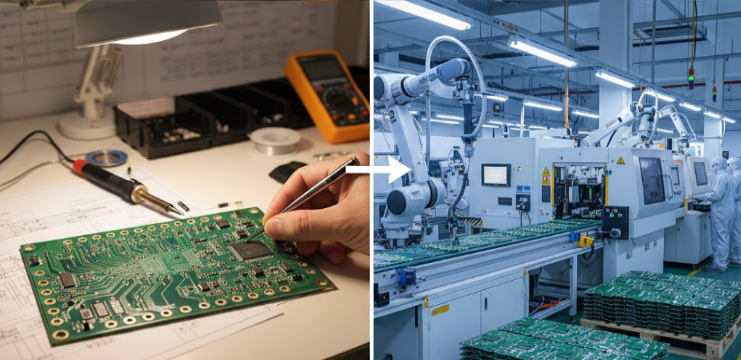
Moving an electronic prototype to mass production requires gated control of manufacturing data, DFM, the BOM, sourcing, prototype verification, pilot production, testing, revisions, ramp-up, and delivery. Each gate needs an owner, acceptance criteria, approved evidence, and a released output before production advances.
Freeze a complete, revision-matched manufacturing package.
Resolve DFM and component risks before ordering production material.
Use prototype and pilot builds to verify the product and the process.
Release volume production only with test evidence and controlled changes.
Define the project and gates
Assign engineering, procurement, quality, project, and manufacturing owners. Define quantities, schedule, compliance scope, tests, outputs, and approval authority.
Release manufacturing data
Provide matched Gerber or ODB++ data, drill files, BOM, centroid file, drawings, schematics, test requirements, programming files, and revision identifiers.
Complete DFM and BOM validation
Close fabrication and assembly findings. Confirm manufacturer part numbers, lifecycle status, availability, approved sources, alternates, and substitution authority.
Build and verify prototypes
Inspect first units, load firmware, run functional and engineering tests, record defects, and update controlled design files before approval.
Validate pilot production
Run production-intent tooling, work instructions, inspection, AOI, applicable X-ray, programming, and functional tests. Review yield and recurring defects.
Approve ramp-up
Release only the approved revision, establish traceability, monitor repeatability, and increase volume in controlled increments rather than assuming one passing unit proves capability.
Handover delivery and ongoing control
Approve shipment records, test results, nonconformance status, packaging, and configuration. Maintain forecasts, component-risk reviews, change control, and corrective actions.
When is a design ready for pilot production?
When prototype issues are closed, files share one revision, BOM risks are accepted, tests are defined, and production-intent tooling and instructions are available.
Can a manufacturer substitute a component?
Only under the agreed change process. Engineering should compare form, fit, function, compliance, firmware, and test effects before documented approval.
What evidence should buyers request before volume release?
Request the approved build package, inspection and functional-test records, pilot findings, deviation status, material traceability, and signed release decision.
Standards, evidence, and decision control

The buyer and supplier should agree contractual acceptance criteria. The IPC-A-610J page published by IPC identifies the standard as acceptance criteria for electronic assemblies. This supports defining the applicable class and revision on the order instead of relying on a general quality statement.
The IPC J-STD-001J description covers materials, methods, and verification requirements for soldered assemblies. Buyers should therefore distinguish process requirements from finished-assembly acceptance evidence.
The International Organization for Standardization explains in ISO 9001 Quality Management Systems — Requirements that a quality management system supports consistent outputs and continual improvement. It does not by itself approve a specific PCBA; project-level inspection and test records remain necessary.
For US medical devices within scope, the FDA's Design Controls guidance addresses documented design changes, verification, validation, and approval. This demonstrates why regulated projects need product-specific change evidence rather than informal revision instructions.
Release checklist
- One approved revision across PCB, BOM, assembly, firmware, and tests
- Closed DFM, sourcing, inspection, and pilot actions
- Approved deviations and substitutions with traceable decisions
- Defined ramp metrics, delivery records, and ongoing production ownership
Before placing a volume order, ask the supplier to provide the evidence behind each gate and compare it with the product's contractual and regulatory scope.