 PCB & PCBA Manufacturer

What Is an FR-4 PCB?
FR-4 (Flame Retardant 4) is the most commonly used material grade in PCB manufacturing. It is made from woven fiberglass cloth reinforced with epoxy resin. The “4” indicates compliance with the UL94 V-0 flammability standard, meaning the material will self-extinguish after ignition.
Thanks to its excellent electrical insulation, mechanical strength, and cost efficiency, FR-4 has become the industry standard for most electronic circuit boards.
FR-4 Material Overview
FR-4 is a flame-retardant, glass-reinforced epoxy laminate. It offers a balanced combination of electrical, mechanical, and thermal performance, making it suitable for a wide range of applications.
Key electrical properties:
Dielectric constant: ~4.5 at 1 MHz (moderate)
Dissipation factor (loss tangent): ~0.02 at 1 MHz (moderate)
These properties allow FR-4 to be used in both low-frequency and moderate-power electronic designs, which is why it is widely used in consumer electronics, industrial controls, and general-purpose PCBs.

F
Glass Transition Temperature (Tg)
The glass transition temperature (Tg) defines how FR-4 behaves under heat and is one of the most important thermal parameters when selecting PCB materials.
FR-4 is commonly classified into three Tg ranges:
Low Tg: 130–140°C
Standard Tg: 150–160°C
High Tg: above 170°C
Higher Tg materials offer better thermal stability, making them more suitable for lead-free soldering, multilayer PCBs, and high-temperature applications.
Structure and Composition of FR-4
FR-4 is a composite material used as the PCB substrate. It consists of three main layers:
1. Woven Fiberglass Cloth (E-glass fibers)
Provides mechanical strength and dimensional stability. It appears as a fine woven fabric inside the laminate.
2. Flame-Retardant Epoxy Resin
Acts as the binding matrix that holds the fiberglass together. It also provides excellent electrical insulation and thermal resistance.
3. Copper Foil (in PCBs)
Thin copper layers are laminated onto the FR-4 substrate using heat and pressure to form circuit traces and electrical connections.
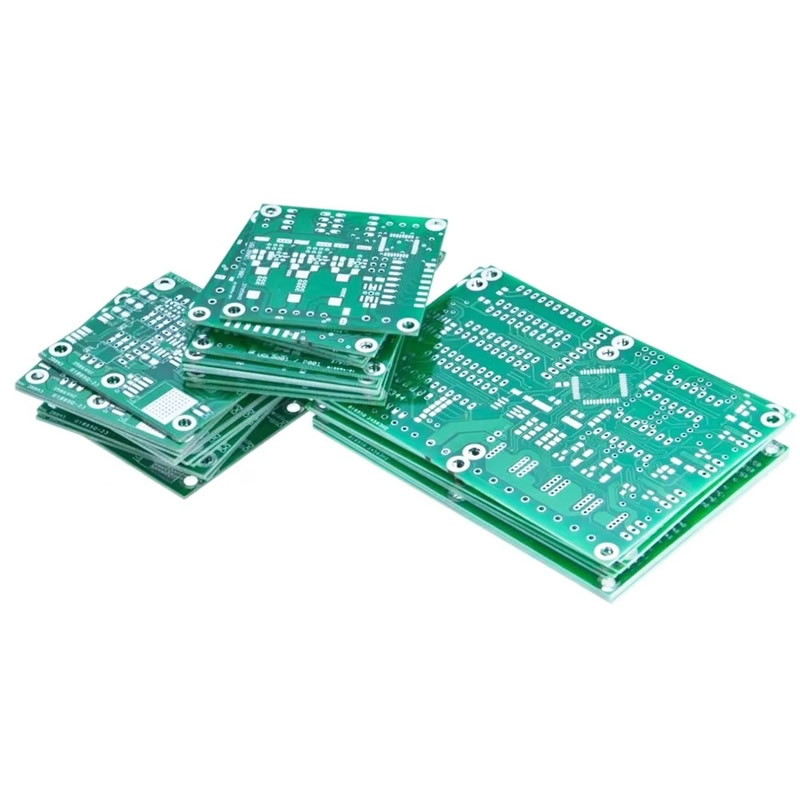
Benefits of FR-4 PCB Material
Cost-Effective and Widely Available
FR-4 is significantly more affordable than high-performance laminates such as Rogers. Its low cost and global availability make it the industry standard for mass production and high-volume PCB manufacturing. Sourcing FR-4 materials is easy and reliable across all major PCB supply chains.
Strong Mechanical Performance
The woven fiberglass structure provides excellent tensile strength and dimensional stability. FR-4 boards resist warping, bending, and mechanical stress, making them suitable for both automated assembly and long-term field use.
Reliable Electrical Insulation
With a moderate dielectric constant, FR-4 performs well in low-frequency and moderate-to-high power applications. The epoxy-fiberglass composite offers strong electrical isolation between layers, helping ensure stable signal integrity and safe operation.