 PCB & PCBA Manufacturer
Parylene Conformal Coating | Ultra-Thin, Pinhole-Free PCBA Protection
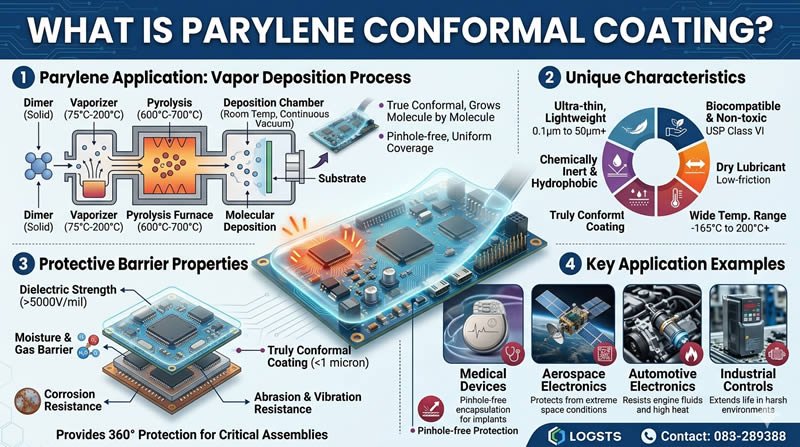
Parylene conformal coating is the gold standard for high-reliability electronics. Unlike liquid coatings, Parylene is deposited as a dry polymer vapor at room temperature, creating an ultra-thin (5-25µm), pinhole-free, and chemically inert barrier that conforms perfectly to any substrate — including sharp edges, deep crevices, and complex 3D surfaces.
What Is Parylene Conformal Coating?
Parylene conformal coating is a unique, vacuum-deposited polymer film that provides complete, uniform protection for printed circuit boards and electronic assemblies. Unlike traditional spray, dip, or brush coatings, the deposition process — known as chemical vapor deposition (CVD) — occurs in a vacuum chamber at ambient temperature. The Parylene monomer gas polymerizes directly onto the substrate surface, creating a coating that follows every contour, even under components.
At Tengxinjie, we provide professional Parylene coating PCB services for medical devices, aerospace systems, military electronics, and other mission-critical applications where zero defects are required. Our Parylene PCBA process is fully qualified to industry standards, including IPC-CC-830 and MIL-I-46058C.
Parylene Conformal Coating
Why Choose Parylene for Electronics Protection?
🔬 Ultra-Thin & Pinhole-Free
Parylene conformal coating achieves complete coverage at thicknesses of just 5-25 microns — significantly thinner than liquid coatings. The vapor deposition process produces a film with no pinholes, cracks, or voids, even on sharp points or under components.
🧪 Chemically Inert & Biocompatible
Parylene for electronics offers exceptional resistance to solvents, acids, bases, and biological fluids. It is USP Class VI certified and ISO 10993 compliant, making it the standard choice for implantable medical devices and in-vivo sensors.
⚡ Superior Dielectric Properties
With a dielectric strength exceeding 7,000 volts per mil (275 kV/mm) and a stable dielectric constant (2.65 at 60 Hz), Parylene coating PCB provides excellent electrical insulation without signal distortion.
🌡️ Wide Temperature & Environmental Stability
Parylene performs reliably from -200°C to +125°C (and briefly up to +350°C in inert atmospheres). It resists UV degradation, moisture ingress (less than 0.1% water absorption), and outgassing, meeting NASA low-outgassing specifications for aerospace use.
Parylene Types: N, C, D, HT — Which One Is Right for You?
Parylene N (Poly-para-xylylene)
Highest dielectric strength and penetrating ability. Best for deep crevices, MEMS devices, and applications requiring the lowest dielectric constant.
Parylene C (Most Common)
Excellent combination of barrier properties, dielectric strength, and chemical resistance. Widely used for medical devices, PCBs, and general high-reliability electronics.
Parylene D
Higher thermal stability and chemical resistance than Type C. Suitable for high-temperature applications (up to 125°C continuous).
Parylene HT (High-Temperature)
Replaces CDC with fluorine substitution. Exceptional thermal stability (up to 450°C short-term) and UV resistance. Ideal for LED, automotive, and high-temperature sensors.
Parylene Conformal Coating Technical Specifications
| Parameter | Parylene Coating Capability |
|---|---|
| Coating Types | Parylene N, Parylene C, Parylene D, Parylene HT (depending on application) |
| Deposition Method | Chemical Vapor Deposition (CVD) — room temperature, vacuum chamber |
| Typical Thickness | 5 – 25 µm (0.2 – 1.0 mil) — up to 50 µm available upon request |
| Dielectric Strength | > 7,000 V/mil (275 kV/mm) for 5µm film |
| Dielectric Constant | 2.65 at 60 Hz (Parylene C) |
| Water Absorption | < 0.1% (24-hour immersion) |
| Temperature Range | -200°C to +125°C continuous; higher for Parylene HT |
| Compliance | IPC-CC-830, MIL-I-46058C, USP Class VI, ISO 10993, NASA low-outgassing |
| Color | Water-clear / transparent |
Critical Applications for Parylene PCBA Protection
🏥 Medical Devices
Implantable pacemakers, cochlear implants, neurostimulators, catheters, and surgical instruments. Parylene conformal coating is USP Class VI certified and biocompatible.
✈️ Aerospace & Defense
Avionics, navigation systems, missile guidance, satellites, and radar electronics. Parylene withstands extreme temperatures, vibration, and vacuum conditions.
🚗 Automotive & EV
Sensor modules, SDVs, battery management systems (BMS), and high-temperature power electronics. Parylene HT offers exceptional thermal stability.
📡 MEMS & Sensors
Pressure sensors, accelerometers, microphones, and microfluidic devices benefit from Parylene’s ultra-thin, conformal, and low-friction properties.
🔋 Energy Storage
Battery protection circuits, fuel cells, and supercapacitors benefit from Parylene’s chemical resistance and dielectric strength.
📱 Consumer Electronics
Wearables, hearables, smartwatches, and portable devices requiring reliable moisture and sweat protection without adding bulk.
Why Choose Tengxinjie for Parylene Coating?
✅ Dedicated Parylene Deposition Equipment
Our CVD chambers are sized for PCB panels and complex assemblies up to 24″ x 24″. We control deposition parameters precisely to achieve uniform thickness across every surface.
📋 Full Masking & Fixturing Capability
We provide precision masking for connectors, test points, and other keep-out areas using industry-proven tapes, boots, and selective removal techniques.
🔬 Quality Control & Documentation
Every batch includes thickness measurement (using eddy current or FTIR), adhesion testing, and pinhole inspection. Full documentation available for medical and aerospace compliance.
🌍 Global Regulatory Support
We support ISO 13485 (medical), IATF 16949 (automotive), AS9100D (aerospace) requirements, including First Article Inspection (FAI) and Certificate of Conformance (CoC).
Ready to Protect Your High-Reliability Electronics with Parylene?
Upload your PCB files, assembly drawings, and coating specifications. Our engineering team will review your requirements, recommend the optimal Parylene type (N, C, D, or HT), and provide a detailed quote within 24 hours.
✔ NDA Available ✔ ISO 9001:2015 ✔ IPC-CC-830 ✔ USP Class VI (Medical) ✔ NASA Outgassing Compliant
Frequently Asked Questions (FAQs)
WeChat
Scan the QR Code with WeChat