 PCB & PCBA Manufacturer
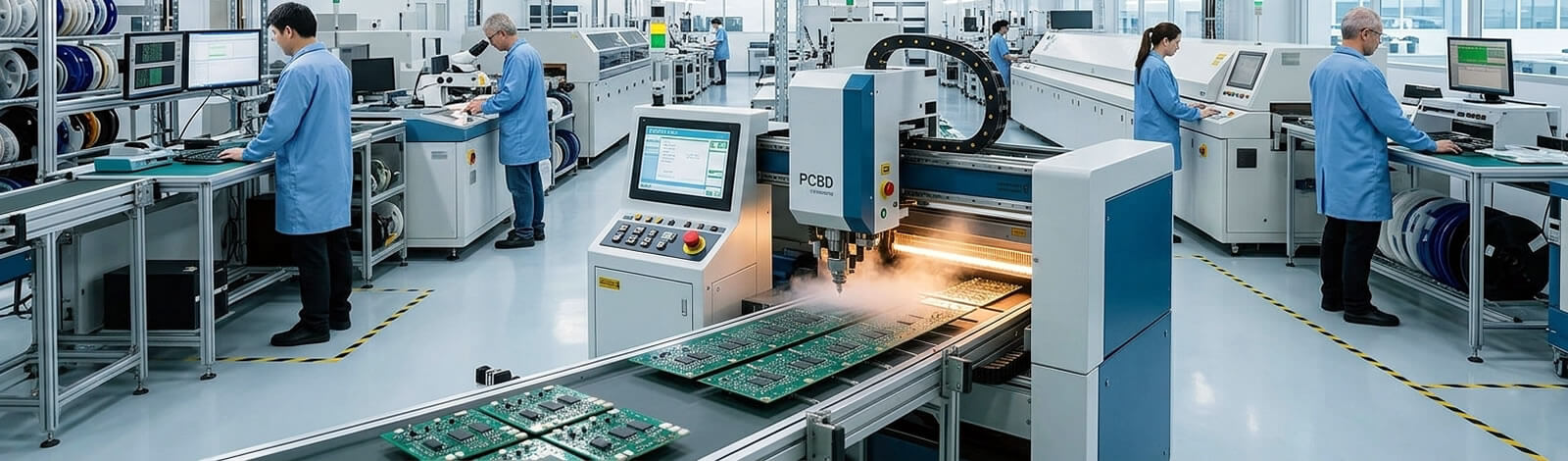
Optimized Article (Suitable for European & American Audiences)
Title: Through-Hole PCB Assembly | A Complete Guide to PTH Technology & Process
Introduction
Through-hole PCB assembly (also known as PTH assembly) is a foundational technology in electronics manufacturing. It involves inserting component leads through pre-drilled, copper-plated holes on a printed circuit board and soldering them on the opposite side to create a robust mechanical and electrical connection.
While Surface Mount Technology (SMT) dominates high-density designs, through-hole assembly remains essential for components requiring mechanical strength, high-power handling, and reliable performance in demanding environments. Most professional PCBA projects use a mixed technology approach—combining SMT for compact logic and PTH for durable interface components.
Part 1: What Is Through-Hole PCB Assembly?
Through-hole PCB assembly connects PTH (Plated Through-Hole) components to a PCB. These components, also called DIP (Dual In-line Package) components, have long leads that pass through holes drilled in the board. The holes are plated with copper during PCB fabrication, creating a conductive path from one side of the board to the other.
Most PTH components are radial components, meaning their leads extend in the same direction. In standard through-hole assembly, these components are inserted manually—a practical approach given that most modern PCBA projects have a small number of PTH parts.
An advanced variation, PIH (Paste-In-Hole) technology, allows certain DIP components to be reflow-soldered alongside SMT parts. The component leads are pressed into holes pre-filled with solder paste and then passed through a reflow oven.
Part 2: Solving Common PTH Assembly Challenges
Working with an inexperienced PCBA manufacturer can lead to quality issues. An expert partner like Tengxinjie anticipates and solves these challenges.
Challenge 1: High Requirements for Industrial-Grade PTH Assembly
Industrial boards (e.g., high-power inverters) demand specific soldering fullness, precise tin volume, and effective thermal dissipation.
Tengxinjie’s Solution: We skillfully design fixtures for wave soldering and control oven temperatures precisely to meet the soldering requirements for high-power, high-current PCBA applications.
Challenge 2: Preventing Component Floatation During Wave Soldering
“Floatation” occurs when PTH components rise above their intended position during wave soldering, caused by improper manual placement or thermal expansion of materials. This creates gaps and uneven surfaces.
Tengxinjie’s Solutions:
Design wave soldering jigs that physically press down on components prone to movement.
Apply a thin layer of adhesive to the bottom of critical components (e.g., buttons, sockets) that must fit precisely within an enclosure.
Recommend selective soldering (instead of wave soldering) for projects with sufficient budget, as it eliminates floatation, reduces thermal shock, and requires no jig.
Part 3: The Through-Hole PCB Assembly Process
Through-hole assembly is semi-automatic and typically occurs after SMT assembly.
Standard PTH Assembly Process:
Component Insertion: Technicians manually insert PTH component leads through the PCB holes, pressing them firmly into place.
Wave or Selective Soldering:
The PCBA is placed in a jig that protects soldered SMT components.
Flux is applied, and the board is preheated.
For wave soldering, the bottom of the board passes over a wave of molten solder for 10-15 seconds.
For selective soldering, a precision nozzle solders each PTH joint individually—ideal for thermally sensitive boards or those with mixed soldering requirements.
Lead Trimming: Technicians trim component leads protruding from the PCB to 1-2mm in length.
Cleaning & Visual Inspection: Flux residue is cleaned, and a visual inspection checks for incomplete soldering, which is corrected with a manual soldering iron.
Post-Assembly Tests & Services: At Tengxinjie, we offer conformal coating, functional testing, IC programming, thermal aging, and box build assembly to ensure quality, function, and longevity.
PIH (Paste-In-Hole) Assembly Process (Alternative for Selective Components):
Solder Paste Printing: Solder paste is pressed through a stencil and into the PTH holes on the bare PCB.
Solder Paste Inspection (SPI): An SPI machine verifies the thickness, position, and shape of the solder paste in each hole.
Component Insertion: DIP components are pressed into the solder-filled holes.
Reflow Soldering: The board passes through a reflow oven where the solder melts, forming a strong metallic bond between the component lead, solder, and copper hole wall.
Part 4: Pros and Cons of Through-Hole PCB Assembly
| Advantages | Disadvantages |
|---|---|
| Strong mechanical bond — ideal for components under stress or vibration | Space constraints — holes limit routing space on inner layers |
| High durability — suitable for high-speed or high-vibration operations | Not suitable for high density — larger trace widths and component sizes prevent miniaturization |
| Cost-effective for prototypes & small batches — no specialized tooling required | Not ideal for high volume — manual insertion is slower than automated SMT |
| Handles high-voltage, high-power, and high-stress components (connectors, transformers, large capacitors) | Component size — DIP components are physically much larger than SMDs |
Part 5: Applications of Through-Hole PCB Assembly
While unsuitable for compact consumer gadgets, through-hole assembly excels in applications requiring durability and power handling, including:
Power supplies and industrial control boards
High-power industrial inverters
EV chargers and charging stations
Automotive communication control modules
Audio/video decoding motherboards
Thermal dissipation systems for high-performance CPUs/FPGAs
Part 6: Why Choose Tengxinjie for Through-Hole PCB Assembly?
High-quality through-hole assembly demands expertise in jig design, soldering temperature control, and production workflow. Tengxinjie is a one-stop PCBA manufacturer with proven experience in complex PTH assembly.
Our Capabilities & Advantages:
Full Attention to Detail: We meticulously control jig design, oven temperatures, and production procedures to ensure PTH assembly success.
Wave & Selective Soldering: Both methods available—we recommend the right process for your specific component mix and thermal sensitivity.
One-Stop Service: R&D support, PCB fabrication, component sourcing, PCB assembly, and box-build assembly under one roof.
Cost-Effective & High-Quality: Competitive pricing without compromising on materials, processes, or inspections.
Free Sample & Functional Testing: For bulk production orders, we provide a free PCBA sample and comprehensive functional testing.
Part 7: How to Get a Through-Hole PCB Assembly Quote
Upload your BOM and Gerber files through our online order system. Our engineering team will review your requirements, perform a DFM check, and provide a detailed quote—typically within 24 hours.
For complex projects requiring application-specific guidance, contact Tengxinjie directly to speak with one of our PCBA technical experts.
Working on automotive, industrial, IoT, or consumer electronics projects?.
We provide professional PCB assembly services including SMT, DIP, and full turnkey solutions.
Send us your BOM, Gerber files, or project requirements and get a fast, accurate quotation from our engineering team.
✔ NDA Available ✔ Fast Quotation Within 24 Hours ✔ ISO Certified Factory ✔ One-stop PCB & PCBA Service
WeChat
Scan the QR Code with WeChat