 PCB & PCBA Manufacturer
Epoxy Conformal Coating | Hard, Chemical-Resistant PCBA Protection
Epoxy conformal coating provides a hard, durable, and chemically resistant protective layer for printed circuit board assemblies operating in harsh industrial, automotive, and aerospace environments. Unlike softer acrylic or silicone coatings, epoxy forms a rigid, high-adhesion barrier that withstands repeated exposure to fuels, solvents, hydraulic fluids, and mechanical abrasion.
What Is Epoxy Conformal Coating?
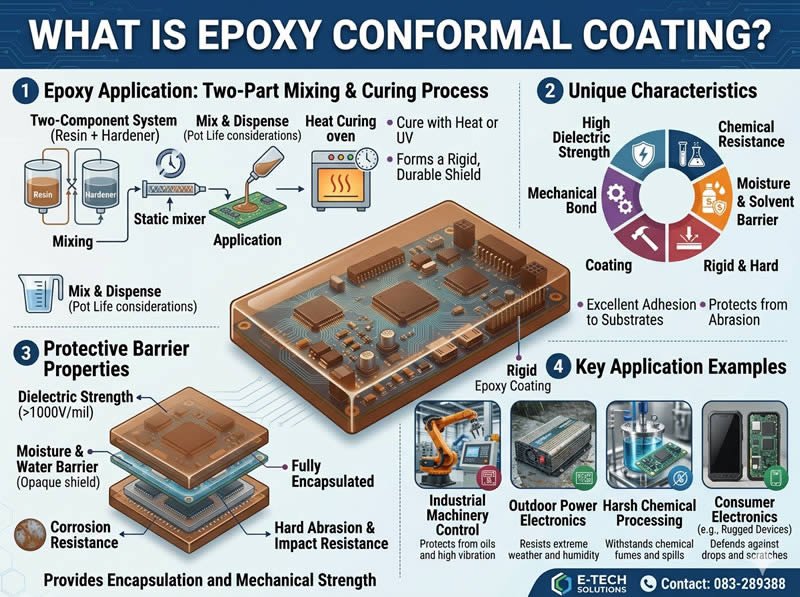
Epoxy conformal coating (also known as conformal coating epoxy) is a two-part (resin and hardener) polymer system that cures to form a tough, cross-linked thermoset film. Unlike thermoplastics (acrylic, some silicones), epoxy coatings cannot be re-melted or re-dissolved once cured — providing exceptional long-term stability and chemical resistance.
At Tengxinjie, we provide professional epoxy coating PCB services using automated selective spray systems, manual spray, or dip-coating methods. Our epoxy PCBA protection process is fully compliant with IPC-CC-830 and RoHS standards, making it suitable for mission-critical applications where durability and chemical resistance are paramount.
Epoxy Conformal Coating
Key Benefits of Epoxy Conformal Coating
🛡️ Exceptional Hardness & Abrasion Resistance
Epoxy conformal coating cures to a rigid, high-durometer film that resists scratching, gouging, and mechanical wear during assembly, handling, and field operation. This makes it ideal for boards subject to physical contact or vibration.
🧪 Superior Chemical & Solvent Resistance
Conformal coating epoxy withstands prolonged exposure to fuels, oils, hydraulic fluids, dilute acids, bases, and industrial cleaning solvents — significantly outperforming acrylic and many silicone formulations.
💧 Excellent Moisture & Humidity Protection
Epoxy coating PCB provides a highly effective barrier against moisture ingress, preventing corrosion, dendritic growth, and electrical leakage in humid or condensing environments.
🔗 High Adhesion to Multiple Substrates
Epoxy systems exhibit exceptional adhesion to FR-4, ceramic, metal, and many plastic substrates without requiring specialized primers. This ensures complete, long-lasting protection even on difficult surfaces.
How Does Epoxy Compare to Other Conformal Coatings?
Epoxy vs. Acrylic
Epoxy offers much higher chemical resistance, hardness, and abrasion resistance. Acrylic is easier to rework and recoat but is softer and less resistant to solvents. Epoxy conformal coating is preferred for industrial and automotive applications; acrylic is common for consumer electronics and field-repairable assemblies.
Epoxy vs. Silicone
Silicone provides superior thermal stability and flexibility across a wide temperature range (-40°C to +200°C) but has lower chemical resistance and tear strength. Epoxy coating PCB is harder, more chemically resistant, and adheres more strongly, but it is less flexible and may crack under extreme thermal cycling.
Epoxy vs. Urethane
Both offer excellent chemical resistance. Urethane is generally more flexible and impact-resistant; epoxy is harder and provides superior adhesion. Conformal coating epoxy is often specified for static, high-wear environments, while urethane may be chosen for flexible assemblies or those subject to vibration.
Epoxy vs. Parylene
Parylene is ultra-thin, pinhole-free, and biocompatible — ideal for medical and aerospace. Epoxy PCBA protection is thicker, harder, and significantly less expensive. Choose epoxy for industrial, automotive, and general-purpose harsh environment electronics where ultra-thin coverage is not required.
Epoxy Conformal Coating Technical Specifications
| Parameter | Epoxy Coating Capability |
|---|---|
| Coating Type | Two-part epoxy (solvent-based or solvent-free options available) |
| Application Methods | Automated selective spray, manual spray, dip coating, brush |
| Typical Thickness | 25 – 130 µm (1 – 5 mils) — thicker coatings available for additional protection |
| Curing Method | Thermal cure (typically 15-60 minutes at 100-150°C) or room temperature (24-48 hours) |
| Temperature Range | -40°C to +130°C (intermittent exposure to higher temperatures possible with specialized formulations) |
| Dielectric Strength | 1,500 – 3,000 V/mil (depending on thickness and formulation) |
| Hardness (Shore D) | 70 – 85 (fully cured) |
| Water Absorption | < 0.2% (24-hour immersion) |
| Compliance | IPC-CC-830, RoHS, UL (specific grades upon request) |
| Color | Clear, amber, or opaque (custom colors available for volume orders) |
Primary Applications for Epoxy Conformal Coating
🏭 Industrial Controls
PLC modules, motor drives, power supplies, and factory automation equipment exposed to dust, humidity, oils, and industrial chemicals. Epoxy conformal coating provides long-term protection in manufacturing environments.
🚗 Automotive Electronics
Engine control units (ECUs), transmission controllers, battery management systems, and under-hood sensors subject to fuels, oils, temperature extremes, and vibration.
✈️ Aerospace & Defense
Avionics, navigation systems, missile guidance, and ground support equipment requiring proven chemical resistance and mechanical durability.
⚡ Power Electronics
Inverters, converters, and high-voltage power supplies operating in dusty, humid, or chemically contaminated environments.
🔋 Energy Storage
Battery protection circuits, BMS boards, and fuel cell controllers requiring moisture and corrosion resistance.
🛠️ Heavy Equipment & Off-Highway
Construction, agricultural, and mining equipment electronics exposed to extreme dust, moisture, and chemical contamination.
Why Choose Tengxinjie for Epoxy Conformal Coating?
✅ Precision Application Equipment
Our automated selective spray systems apply epoxy coating PCB with ±1mm accuracy, reducing overspray, minimizing masking requirements, and ensuring consistent thickness across every board.
🔬 Full Process Control & Inspection
Every coated board undergoes thickness measurement, UV/visual inspection, and adhesion testing to verify coating quality. We provide full traceability documentation for each batch.
🧪 Material Selection & Engineering Support
Not sure which epoxy formulation is right for your operating environment? Our technical team provides material recommendations, mask design, and DFM feedback to optimize coating performance and cost.
🌍 Global Compliance & Documentation
All processes comply with IPC-CC-830 and RoHS. We support automotive (IATF 16949), industrial, and aerospace requirements with complete CoC, FAI, and test reports.
Ready to Protect Your PCBA with Epoxy Conformal Coating?
Upload your files and coating specifications. Our engineering team will review your design, recommend the optimal epoxy system, and provide a detailed quote within 12-24 hours.
✔ NDA Available ✔ ISO 9001:2015 ✔ IPC-CC-830 Compliant ✔ Fast Turnaround ✔ Automotive & Industrial Support
Frequently Asked Questions (FAQs)
WeChat
Scan the QR Code with WeChat